

UPDATE: Jan. 8, 2026: Ørsted’s 924-MW Sunrise Wind project also filed a legal challenge to the Trump administration’s stop work order on Tuesday, asking for an injunction against it from the U.S. District Court for the District of Columbia.
The stop work order will cost Sunrise Wind over $1 million per day, according to the motion. The project is being developed off the coast of New York, with completion expected in 2027.
“Sunrise Wind has carefully sequenced its construction schedule and has contracted specialized vessels necessary for Project construction,” the filing said. “These specialized vessels are in limited supply globally and are tightly scheduled, with little or no availability to work beyond the contracted reservation dates.”
Dominion Energy Virginia and its 2.6-GW Coastal Virginia Offshore Wind project filed a complaint against the administration on Dec. 23, saying the pause is costing the utility more than $5 million per day and noting that Dominion has already spent $8.9 billion to develop CVOW so far, with its customers bearing the cost of all this.
In a Wednesday filing, Dominion objected to the administration’s refusal to divulge the nature of the national security concerns that it said necessitated the pause.
“DEV has continued its diligent efforts outside the litigation to gain visibility into the nature of the alleged ‘national security threat’ purportedly posed by DEV’s CVOW project, even via an unclassified summary,” Dominion said.
However, on Jan. 6, the Bureau of Ocean Energy Management told Dominion the Department of Defense is “awaiting the resolution of the litigation before they would consider sharing the classified information with CVOW.”
“Federal agencies have a longstanding and established practice of sharing classified information with DEV as an operator of critical infrastructure that supports the military,” Dominion said. “The government’s December 31 and January 6 communications depart from this practice without explanation, and foreclose any possibility that the government will follow normal protocols and timely share the information at the crux of BOEM’s Order outside this litigation—in any form and even with DEV personnel with ‘secret’ level clearance.”
Vineyard Wind Offshore, which is developing the 800-MW Vineyard Wind 1 offshore Massachusetts, is the lone project developer out of the five impacted so far that has not filed a legal complaint against the Trump administration’s stop work order. The project is partially delivering power, and in a Dec. 22 letter from BOEM, the agency gave the project permission to “continue any activities from those wind turbines that are necessary for the current level of power generation.”
Dive Brief:
- The 700-MW Revolution Wind project offshore Rhode Island, a subsidiary of Ørsted, “now once again faces enterprise-level threats” due to a blanket stop work order the Trump administration has levied against the offshore wind industry, attorneys for the project argued in a Friday motion requesting an injunction against the order.
- More than $5 billion has been spent on the project so far, and the stop work order is estimated to cost the project at least $1.44 million per day, the motion said. The project is a 50/50 joint venture between Ørsted and Global Infrastructure Partners’ Skyborn Renewables.
- The 810-MW Empire Wind 1 project offshore New York also filed a complaint against the order on Friday. Empire Wind developer Equinor said in a release that the order is “unlawful and threatens the progress of ongoing work with significant implications for the project.”
Dive Insight:
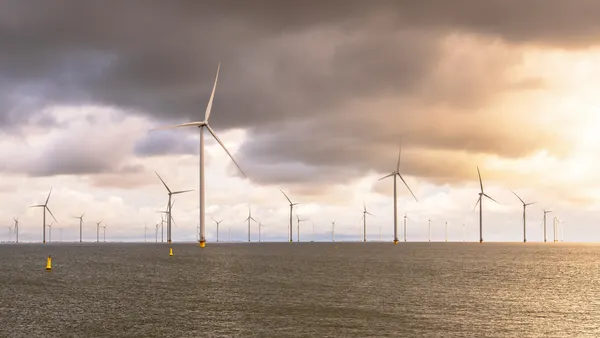
The Department of the Interior announced in December that it is pausing the leases for “all large-scale offshore wind projects under construction” in the United States due to national security risks.
In its motion for an injunction, Revolution Wind argued that the Bureau of Ocean Energy Management already reviewed the project’s impacts on national security and said the Department of Defense, U.S. Coast Guard and Federal Aviation Administration “extensively reviewed” the project “at each stage of the regulatory process.”
“In November 2024 Revolution Wind entered into a mitigation agreement with [DOD] and the Air Force to address national security risks and to mitigate potential adverse effects on military operations and readiness, including to protect military radar systems,” the motion said.
Interior Secretary Doug Burgum said in December that the projects could pose risks due to “the rapid evolution of the relevant adversary technologies” and cited national security risks “identified by the [Department of Defense] in recently completed classified reports.”
However, in a post on X about the decision, Burgum criticized the projects from an unrelated perspective, saying that “ONE natural gas pipeline supplies as much energy as these 5 projects COMBINED,” along with calling offshore wind “expensive, unreliable,” and “heavily subsidized.”
The stop work order is affecting five major offshore wind farms under development in federal waters off the East Coast: the largest U.S. project, the 2.6-GW Coastal Virginia Offshore Wind; the 800-MW Vineyard Wind 1 offshore Massachusetts; Revolution Wind; and Empire Wind 1 and the 924-MW Sunrise Wind, both offshore New York.
Empire Wind said in its complaint that the order represented an “arbitrary and capricious change in position without adequate explanation or acknowledgement of Empire Wind’s significant reliance interests” and noted that the project already incurred an estimated $200 million in delay costs in April last year, when the Trump administration issued a targeted stop work order against it.
Empire Wind argued that the government does “not have unfettered discretion to halt work on an offshore lease” and that the terms of the lease specify that advance notice “will normally be given before requiring a suspension or evacuation.”
“These limitations endow Empire Wind with an expectation that its lawful activities may continue and that the [Construction and Operations Plan] Approval and Lease will continue to remain effective in the absence of the government’s exercise of this limited authority,” Empire Wind said.